
A Total Eclipse Is An Art
And you, of course, are the artist
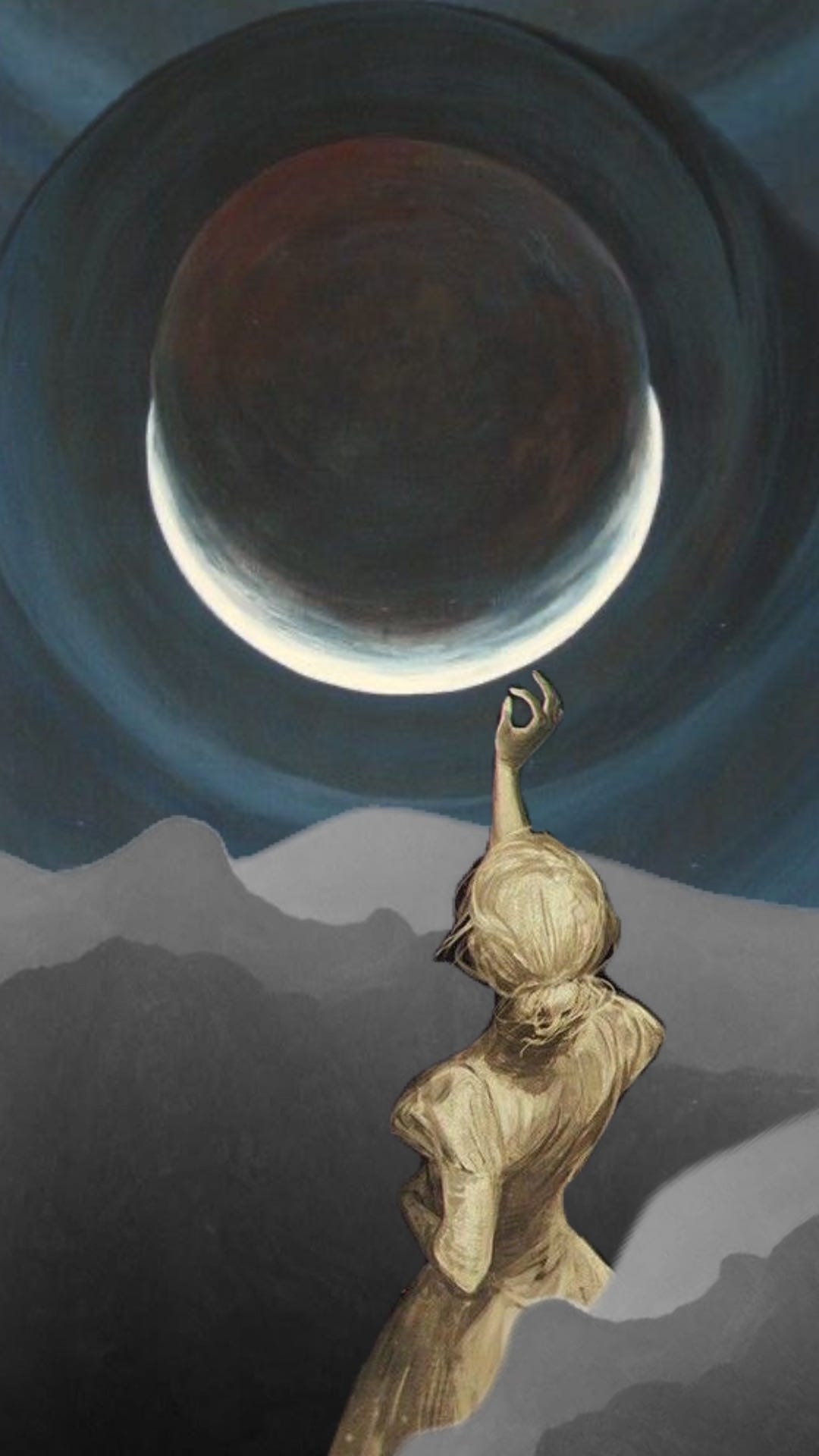
Eclipse are wild things. The sun or the moon become blocked from view – covered, veiled, hidden – and the sky suddenly seems unnatural. We’ve never been comfortable with this, even in the modern age when our curiosity has gotten the better of us and we follow instructions on how to make eclipse glasses so that our eyes don’t burn. We step outside and tell each other that it’s so cool but secretly we shiver a little bit, unnerved by the wrongness of the sky. An eclipse can feel like a wound in the sky, or a bruise; an unexplained injury that scars the firmament, if only for a moment.
Many traditions avoid rituals during eclipses, for a variety of reasons, not least because the energy is intense. Eclipses are disruptive. Eclipses mess with our expectations. Eclipses remind us that the universe has its own way of doing things.
And as with most unnerving things that happen in nature, we’ve often blamed women for them, at least in myth and legend. They’re frequently said to be the fault of angry goddesses or vengeful lady spirits or whatever variety of spiteful feminine-coded divine figure happened to make the most convenient story at the time. It’s convenient, of course, because night and dark and the moon and shadow are all associated with the feminine, so it’s not a reach, but some of the stories are a little grim. The Aztecs told stories about their moon goddess Coyolxāuhqui re-enacting her own death with each lunar eclipse: the moon in these stories is her decapitated head, and the shadow crossing it represents her head being thrown into the sky by her murderous brother. Amaterasu, the goddess of the sun in Japanese mythology, is said to have hidden herself away in a cave out of anger and cast the world into darkness–a cosmic sulk slash solar eclipse that lasted as long as it took the other gods to talk her out of it.
An eclipse is a moment in which our primary astral bodies are removed from sight. They’re stolen from us, briefly; hidden, veiled, concealed. It’s no wonder that we tell stories in which that’s a punishment, in which we imagine that some angry deity is teaching us, or someone, a lesson. Even when we marvel at the phenomenon, we harbor a tiny fear that one day, the sun or the moon will go dark forever, that they’ll be taken away from us. Maybe some part of us worries that we might deserve it.
I love eclipses. I love that they remind us that not everything that happens in nature and in the universe is for us. I like that they make us a little uncomfortable. And I like that the stories that surround them remind us that the god(desse)s get angry, that they have moods and that those moods can get dark. For me, an eclipse is the perfect moment to reflect on the inevitability of female/feminine/othered fury in a universe where so much is withheld from us or taken from us. We are all like Coyolxāuhqui, flinging our heads against the dark in defiance; sometimes we are Amaterasu, hiding ourselves in our caves. Sometimes we cover, sometimes we flee, sometimes we swallow astral bodies whole. Fight or flight isn’t about weakness; it’s survival. It’s necessary choreography. It’s the deepest parts of us insisting upon their moment of flounce, of shouting a full-throated fuck you at the rowdy, messy, unfair world and then spinning on their heels, swirling their capes and disappearing behind the velvet curtain. I want to be alone.
I think that this moment – or this kind of moment – is extraordinarily powerful if we embrace our own version of it, if we ask ourselves, what’s the story of my own eclipse? Why might I want to pull myself into shadow? What parts of me want to retreat and stew in their own anger or passion – or fling themselves into the sky in righteous defiance of the cosmos? How would I disrupt the day or the night, how would I splatter paint on the portrait of the heavens? If I were to claim my own eclipse moment, blot out the sun or the moon in my story for just a moment, what would that look like? And what might it bring me?
It’s not just goddesses who have done this, after all. Sinéad O’Connor’s famous moment on SNL, shredding the picture of the Pope? That was an eclipse. She blotted out the cultural sun and cast a righteous shadow across the social landscape (and of course was punished for it.) Any time a woman or anyone without power has seized a moment and spoken dark truths with such force that they blot out all light for an instant, that’s an eclipse. And any time they’ve retreated from the stage or pulled away or in any manner gone intentionally dark, that’s also an eclipse. Beyoncé disappears before any major release; Taylor Swift went deeply dark – even wiping her social media and doing a complete blackout of her digital presence – before re-emerging with “Look What You Made Me Do” and her reputation-redefining Reputation era. Sometimes the eclipse means removing yourself from view, because fuck the gaze. Sometimes it means claiming your time as yours, and only yours, because fuck the hustle. Sometimes (most of the time) it means I am in charge of my own sky and I control its light.
The common thread is this: someone taking control of her story by ceasing to participate in the one being written for her. By blotting out the sun of her own narrative, she forces the world – or even just her own world – to notice the darkness she creates and in so doing reveals her power to bring the light back on her own terms. So what if that power is revealed only to herself? Sometimes that’s who most needs the message.
So. What parts of you might be asking to withdraw into darkness — not forever, but long enough to recharge or transform? What anger or grief or deep work do you need to do under the cover of your own darkness? What part of you wants or needs a moment of concealment before embracing its own light?
These aren’t questions for rituals or spells. They’re just invitations to think a little differently about eclipses, and maybe claim one for your own.
Stay sacred(ish),
Catherine
PS: I told a story of my own dark over at Holy Doodlebug. It’s not quite an eclipse moment, but it does yank at some shadows. Cameos by monkeys, AA, and Anne Lamott.